Inspired Designs
“Ideas founded on inspiration and design innovation, created in response to and in harmony with the human experience.”
“Inspired Designs” > My response for the Caleres HQ artist call for entry.
I’m grateful to have the opportunity to submit 5 pieces of art for the Caleres HQ call for entries. Artwork from various artists curated for this new office space that have unique perspectives on the call is an exciting project to be a part of. If you have found your way here through visiting or working in the Caleres St. Louis office, you may have seen this project, but be less familiar with my art and the subjects and techniques I use. I’ll provide some insight to this through the written background to my approach.
MY artistic approach:
The artist call had communicated the desire for each artist to maintain their own unique perspective and style. Allow me to share what my art is about, what inspires me and why I create. I concentrate my subjects on nature and use symbolism and composition in my work to execute a concept, message or area of focus in each work. To communicate an idea clearly, powerfully, I take a subject-first and minimalist style approach. This is not only applied to composition, but the materials used as well. My constant go-to is a simple black ink pen on paper to render complex ideas executed in impactful but simple compositions packed full of intricate details. It’s is a statement in itself to use minimal materials to create small and large scale work.
I also render what I call “slow art.” Using such a small pen device, it takes considerable time to cover a large piece of paper that’s packed full of detail. But that is exactly what commands your attention when you step back and take it in as a whole. Up close one can see a complex network of patterns below the surface. This is inspired by nature in the patters formed by cells, sound, waves, tessellations, spirals… or the patterns of species in migration and in the weaving of their habitat. The second goal I have my work is to draw connections between humans (activity and culture), to nature and the impact we have on wildlife and their natural habitats. My subject typically involves birds as the vessel to symbolize this connection along with natural and human-made objects that reflect a motif; additional contextualization, a message, or a cultural reference. The impact we have on nature is wrapped in beauty and tragedy. There is a romance and a ominous tone, the viewer can decide what to take away. These objects are not always expressed literally, but more conceptual in the compositions to be felt and observed without explanation.
caleres Project Approach:
For the 5 works submitted for this project I think it’s important to share how I arrived at each still life drawing in hopes that the historical nature of how the subjects of design (shoes) came to be (inspirational journey) told through my artistic lens with hidden connections. Thus, bringing a fresh perspective to the relationship we have with history making shoe designs and personal style which is so intrinsic to our human nature of self-expression and function. These shoes inspired many to self-express and created a stir in culture. In researching how each shoe design started and the path from who fueled the design, to where, and in what context in which they were created inspired the still life.
There are more than just these handful of shoes that have heritage significance to Caleres and the long view of this company dating back to the start of Brown Shoe Company by founder George Warren Brown, who started in 1878 as Bryan, Brown & Company. From the initial lines of shoes and boots to the iconic silhouettes and trendsetting styles that will help shape the company from “Shoe Street USA” in St. Louis, to Brown Shoe Company and to it’s current Caleres name we know today. I strive here to achieve striking contrast and a focus on subject with reducing backgrounds and unnecessary noise so the message can be clearly felt and observed, but must be interpreted by the viewer.
I incorporate a connection between human culture and nature through themed objects and bird species in these works. This is my way to bring the history of great shoe designs to my artistic realm of symbolism and culture that reveals truth through objects and commentary. As an artist, most of the symbolism I use are drawn from nature, and bird species which are my most frequent theme (a vessel, in this case, for time and place). I am drawing a relationship between the history of Caleres statement making shoes, the location in which they were conceived, the individuals involved, or the creative process behind the design.
Drawing one:
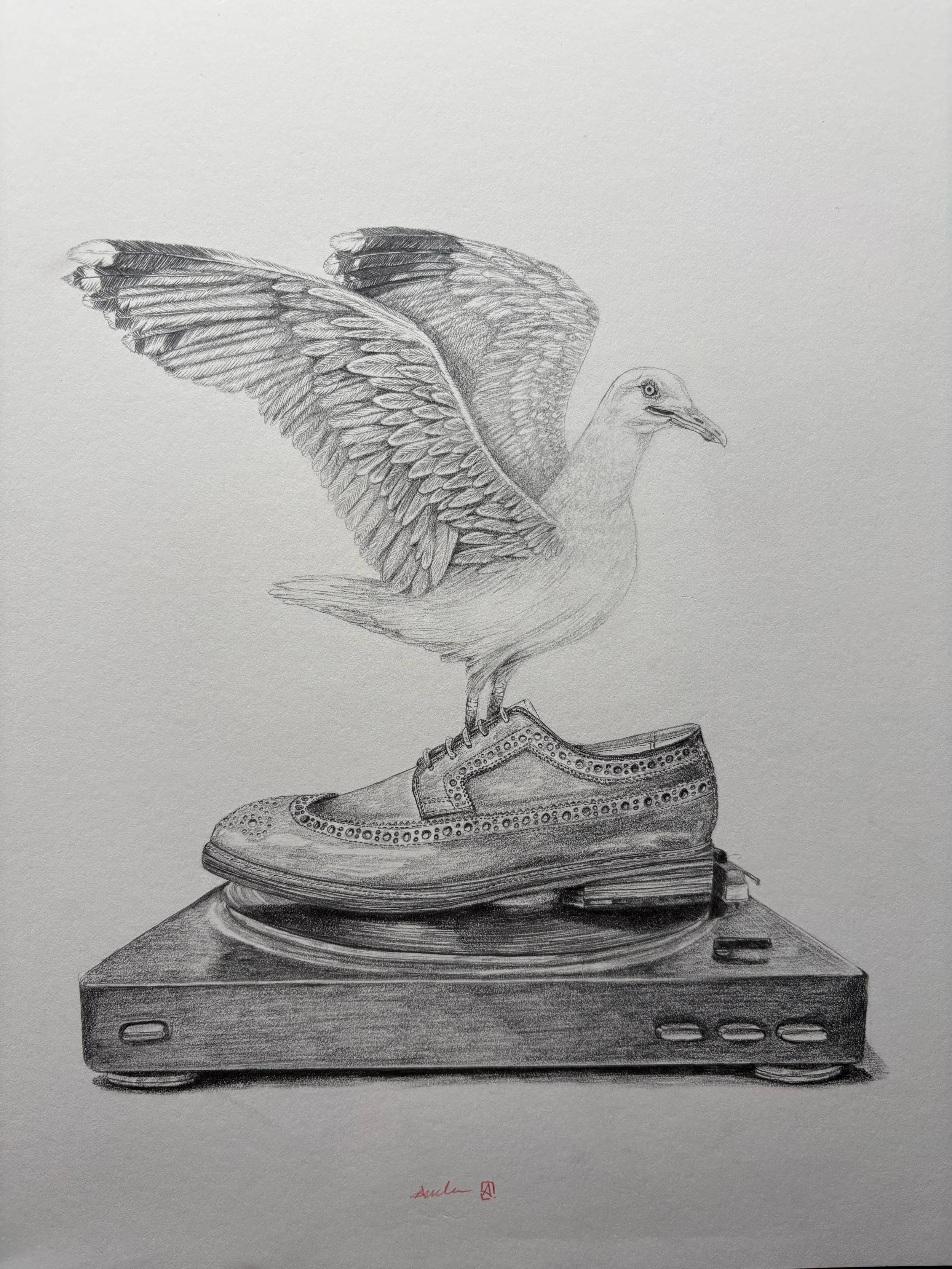
mason
Shoe: Allen Edmonds, Reserve Mason.
This reserve style is a nod to the history of the Park Ave and a hat tip to the evolution of craft and material used in the Reserve line. The goes back to the beginning, the rooting of industrial culture of Port Washington when Allen Edmonds started in 1922. From the beginning, Allen Edmonds has been focused on innovation. In 1922 Elbert W. Allen founded a company in Belgium, Wisconsin that made shoes with responsive cork insoles instead of the awkward metal nails and shanks used in footwear at the time. Due in part to his own abilities as a salesman, Allen’s groundbreaking designs quickly found a following with anyone who appreciated a lighter, more flexible dress shoe that was much more comfortable from the very first wear.
Object: Record Player
Going on in Port Washington at the same time was a busy industry including the Wisconsin Chair Company. They created a subsidiary, Paramount Record Company in order to record and press records to sell with their entertainment cabinet design for a record player built in.
Bird: Out in Port Washington a very common bird around the port was and still is the local native American Herring Gull. Port Washington, Wisconsin, being on Lake Michigan, hosts common backyard birds like American Robins, Black-capped Chickadees, American Goldfinches, House Finches, and American Crows, alongside waterfowl and raptors such as Bald Eagles, Ospreys, Great Blue Herons, Canada Geese, and Belted Kingfishers, with shorebirds common in spring/fall, but specific sightings vary seasonally and by habitat surrounding daily life. I chose the American Herring Gull for it’s local non-migratory population and appearance around the port but also felt like it in conversation with Allen Edmonds as an American made shoe to this day.
Drawing two:
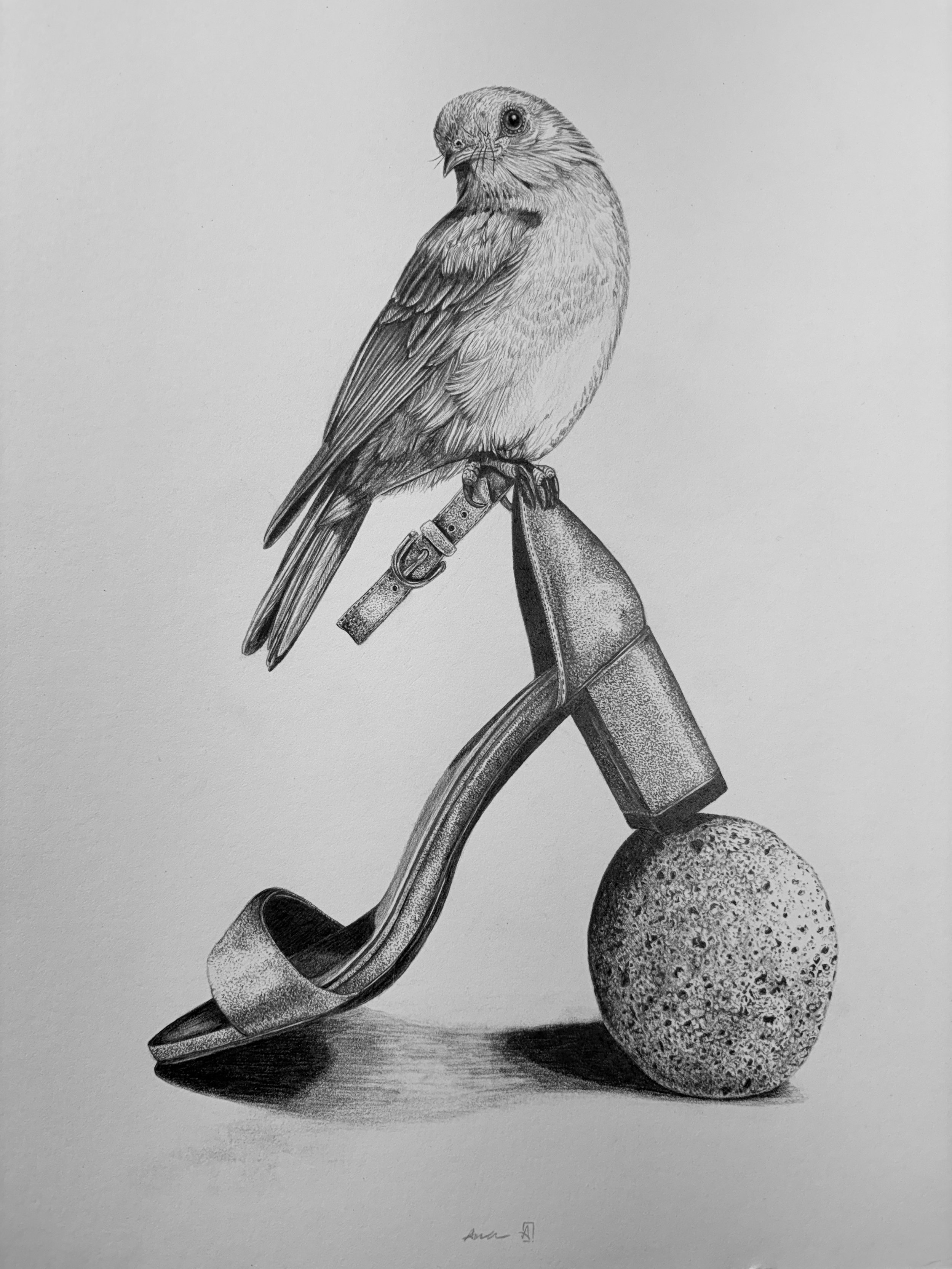
vera
Shoe: Naturalizer, Vera
Symbolizing women's fashion shoes at the heart of design efforts going back to 1927. The Naturalizer brand started with a women’s line of footwear first introduced in America in 1927, in women's fashion footwear and has continually evolved to always deliver the perfect fit. This started on Washington Ave, St. Louis, dubbed “Shoe Street USA.” The streets are still lined with the granite cobblestone blocks once traveled by a teeming garment industry that gave birth to this and other iconic brands. That same year, Missouri identified the Eastern Bluebird as the state bird, which could be found directly in St. Louis and along the Mississippi flyway in abundance. The confluence of the Missouri and Mississippi river allow for an influx of commerce to the area and brought the 1904 Worlds Fair where St. Louis found a boom of urban growth in the city. Reflected in my pencil study below (page 2) are objects that reflect that history and bring my passion around nature and bird species as symbols of drawing humans and nature closer together in a still life composition. In the composition:
Object: Granite
Symbolic of the historic granite stones lining Washington Avenue streets during Shoe Street USA era and still exists today. Granite in this form is a well traveled rounded rock. Tumbled over years to soften the edges and smooth the surface. This is speaking directly to the history of the brand developing both style and comfort in shoe design over the years, but holding steady in timeless style. I also see the granite as the durable foundation to a pursuit for design excellence and how it can endure over time. I’ve used a round stone to reflect the idea that a large rock can be tumbled and weathered into a polished stone over time. So to, does the design process continue to evolve and refine and shape self expression and culture.
Bird: Eastern Bluebird
Symbolic of location and time - Eastern Bluebird, named the state bird in 1927 while the garment industry on Washington Ave, St. Louis, MO “Shoe Street USA” was in bloom. This gave perfect historical context to both the place and time of the events.
Drawing three:
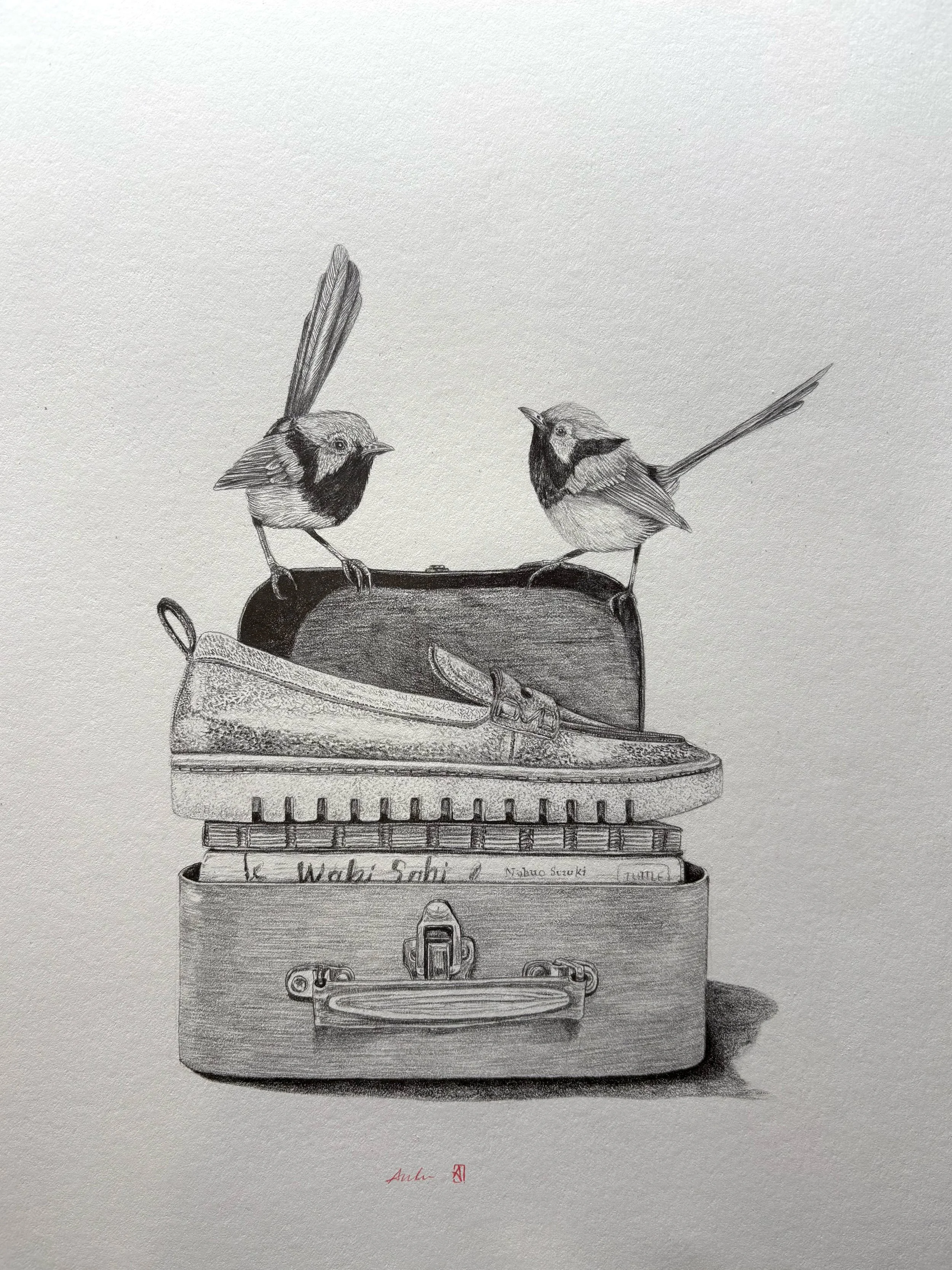
Uptown
Shoe: Vionic, Uptown Loafer
Known for it’s flexible construction making it a pack-able travel shoe that gives effortless style, versatility and comfort, on the go. Vionic was started by Dr. Phillip Vasyli, an Australian Podiatrist with roots. He was hyper focused on the support and comfort shoes could provide through the study of the anatomy in motion related to shoe construction, technology and material. Dr. Vasyli, Australian born, desired to make solutions for foot pain more accessible. The brand made it’s debut in the US market, achieving rapid commercial success with its “Orthaheel” technology. From this success the company rebranded to Vionic, whose name is a blend of bio mechanical technology with contemporary design.
Object: Suitcase
A scaled version of a small suitcase is symbolic of travel and being “on the go” which supports the story of the Uptown design and is ability to fold and pack well for travel. And unpack to wear with anything style. Within the travel case are some books and a sketchbook. The sketchbook isn’t prominent, but a subtle nod to the research put into the technology, suggesting the hidden notes and diagrams Dr. Phillip Vasyli may have kept while doing his initial research for his Orthaheel technology. Also, a book on the subject of Wabi-Sabi, which is the art of observing objects beauty through wear and use, adding character over it’s lifetime to the original object design. A personal attribute through a intimate journey. In this case, imprinted memories through use and travel.
Bird: Australian Variegated Fairy Wren (or the Australian welcome swallow which is a highly traveled migratory bird with unique mud nest design https://en.wikipedia.org/wiki/Welcome_swallow)
Building on the travel theme, let me take you to Australia where you will find the Australian Variegated Fairy Wren. This bird species is found in Brisbane Australia and speaks to the found of Vionic. The bird is very small and cute which feels like a great fit for our travel theme, featured almost as a travel companion that could easily go anywhere with you. The Variegated Fairy Wren is 14 cm long and weights just 6 grams. So small, I featured 2 in this drawing. These birds are very active and restless feeders, particularly on open ground near shelters through lower foliage. A small, active and energetic bird speaking to our on the go travel theme. Their nests are small oval shaped domes that are dense in construction.
Drawing FOUR:
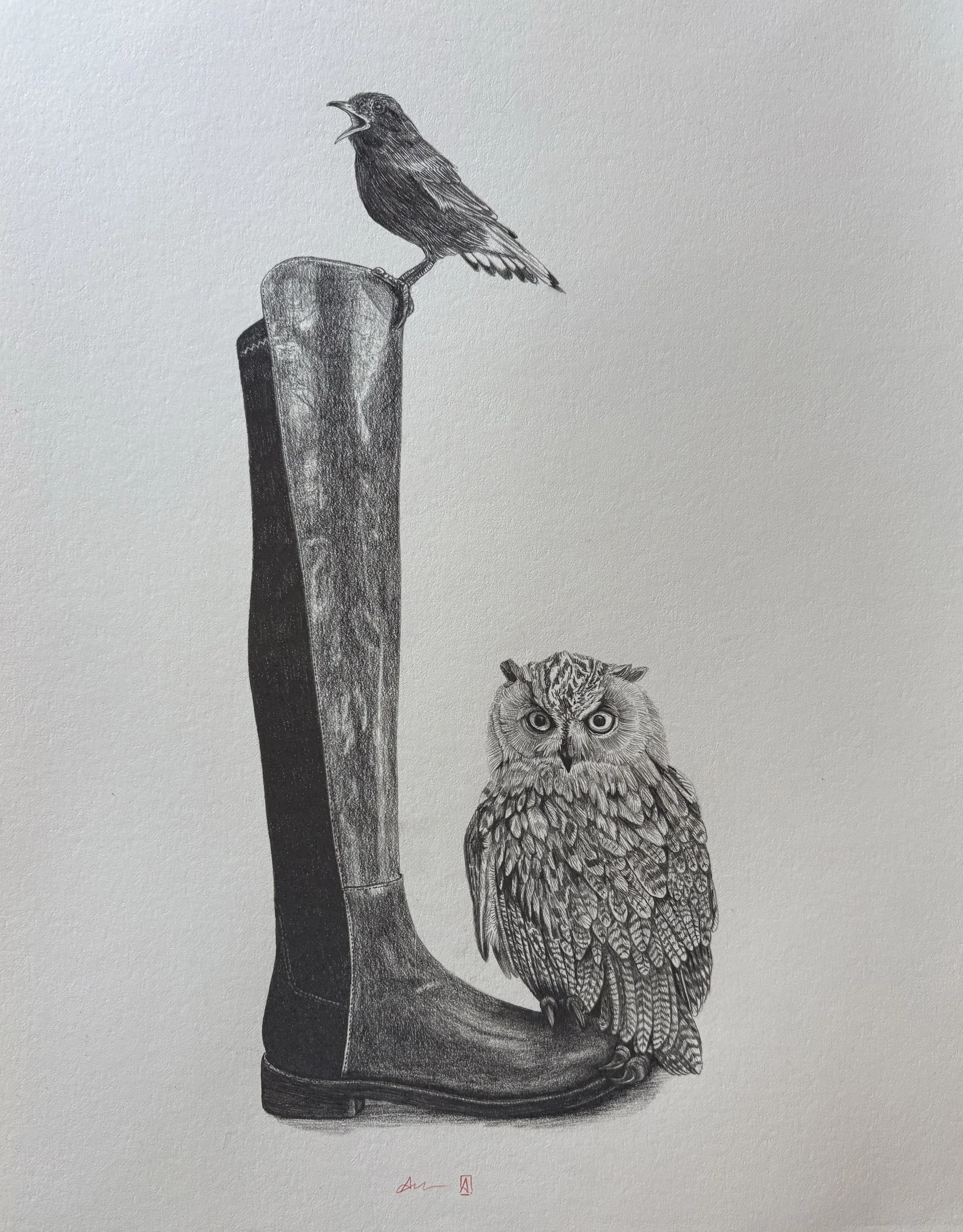
5050
Shoe: Stuart Weitzman, 5050 Boot
Symbolizing the innovation in the 50 / 50 split front back of this tall shaft boot, changing the game, along with SW history as a designer and his commitment to elevated construction in Spain in the demand for quality. Stuart Weitzman's career began working in his father's Massachusetts shoe factory, evolving from a sketch artist to launching his own brand in 1986, known for blending luxury with comfort, exemplified by iconic styles like the 5050 boot and Nudist sandal, eventually selling the company to Coach in 2015 before retiring, all while maintaining a focus on artisanal Spanish craftsmanship and celebrity appeal, notes. In 1986, he launched his own namesake brand, producing most collections in Elda, Spain, famed for its shoemakers. He created "Million Dollar" shoes for Oscar nominees, featuring precious gems, a tradition that ended in 2009 due to the recession. Iconic designs include the 5050 boot (1993) and the Nudist sandal (2013)
Bird: Eagle Owl and the Black Wheatear
Pursuing his passion for the right materials, knowledge and material for construction by going back to Spain with an eye toward finish and quality. Stuart Weitzman's iconic 50/50 boots are handcrafted by skilled artisans in Spain, particularly in Elda, a region known for its shoe making, utilizing premium materials like leather and suede with their signature micro stretch fabric for comfort. You'll often see "Made in Spain" stamped on the soles, confirming their Spanish origin. I also aimed my research on birds toward the same parts of Spain to draw inspiration to represent Stuart’s approach. For this project, I also wanted to the birds to nod to the 50/50 idea by featuring 2 birds instead of 1. I also believe the composition needed it with the tall shaft design of the boot, the feel of the stretched material gave rise to an interesting attitude that feels like a counterweight between fashion and comfort. Both the Eagle Owl and Wheatear birds stand out to me as iconic and identifiable by this region of Spain making them perfect subjects to symbolize the boot construction and origin.
Notes for the symbolic inclusion of these birds: Passion for the right materials: Pursuing the right materials is the Black Wheatear constructs nests into rocky hillsides and cliffs entirely made of small stones gathered during breeding season. The Eagle Owl in Spain is also known as the Bubo Bubo, a nocturnal owl is often seen in pairs perched together searching for pray or singing a duet.
Drawing FIVE:
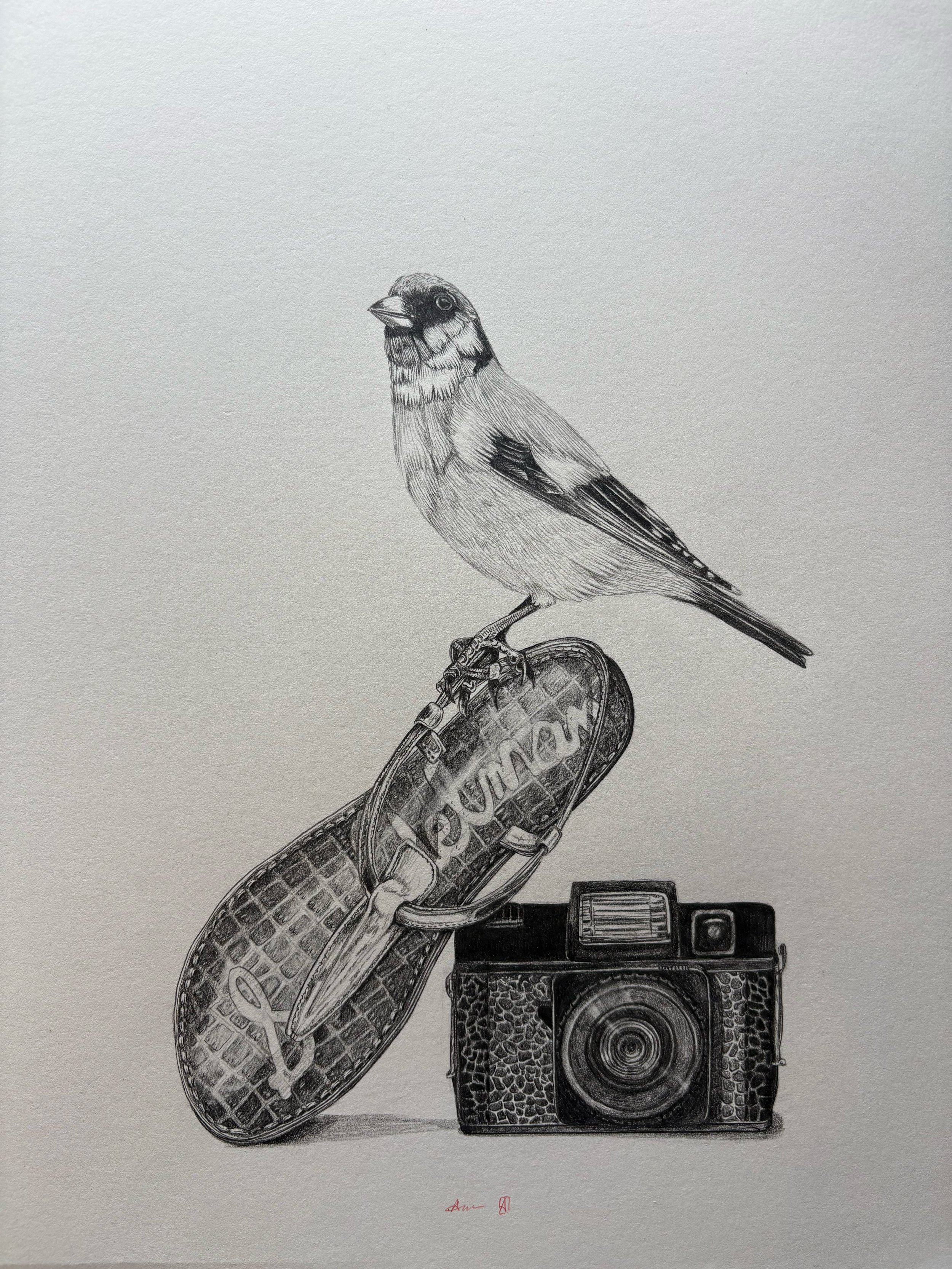
gigi
Shoe: Sam Edelman, Gigi Sandal
This inspired design has been named to the top 100 shoes of all time by Footwear News 2026. The Gigi has had moments in culture on the feet of the famous walking into street culture for us all to see. Sam & Libby started their venture in 1987 after a career defining lead up to starting their own footwear brand. The Hazel pump was part of the 2004 line up and “praised for it’s classic pump design.” The low-cut vamp and leg lengthening effect made it popular in combination with the cushioned sock tech comfort. A timeless American classic style still effective today. However, for this work, during my research, the way Sam Edelman is know to find seasonal inspiration to plan an upcoming collection is what captured my imagination for the composition. Sam, during interviews, has explained his search of new found inspiration is taken directly from street culture. Trips to Europe in and observing people in their daily routine, he would find his muse. The right persona, the right outfit, the right attitude to help inspire the seasonal tone and look of his next collection. The Gigi Sandal is considered a design icon and popular since 2009. This is the sandal that found its way back to the same street culture that Sam was inspired by. Worn by the public and the famous alike.
Object: 120 Film Camera
To tie this composition together, a 120 film style camera is added to accentuate the famous angle of the shoe, but also it’s camera lens type, brings us right back to street level culture. The plastic lens in this camera is a “bubble” which puts the subject of the the photography in focus directly in the center of the frame. For this composition, I’m really speaking to you, the viewer of the work, that is directly in the center of my frame, looking at the composition and asking you to soak in what inspired Sam, his famous Gigi sandal design, who wears it and what personality is all about. Why we wear the shoes we wear and what it says about our individuality. I also love the nostalgia of film that needs light exposure to work with a commitment by the operator who can not easily go back for an edit. You have to be confident in your picture making, to take risks and be ready for the unexpected surprises analogue mediums can take. Crafting and design shoes is a similar creative endeavor.
Bird: European Goldfinch
Looking at local street culture, I turned my research to be inspired by local birds of Europe and Paris specifically. One local non-migratory “garden bird” is the European Goldfinch. The Goldfinch becomes the symbol of local street culture that inspired Sam for his muse, but also a symbolic meaning of who wears the this sandal. While a common bird throughout Europe, the Goldfinch is also a popular subject of famous paintings such as the Dutch painter, Carel Fabritius, who featured the species in a small oil on panel painting titled the “The Goldfinch” (1694) known for it’s vivid brushwork and tromp-l’oeil styles light technique.