
The smallest details, millions of lines.
I often get asked about the level of detail in my work. The larger the work, the more details. The second question I get is "how long did that take you?" The truth is, I just got to the point where I have the right amount of details, but I can push it further. As far as time, I'll come to that later.
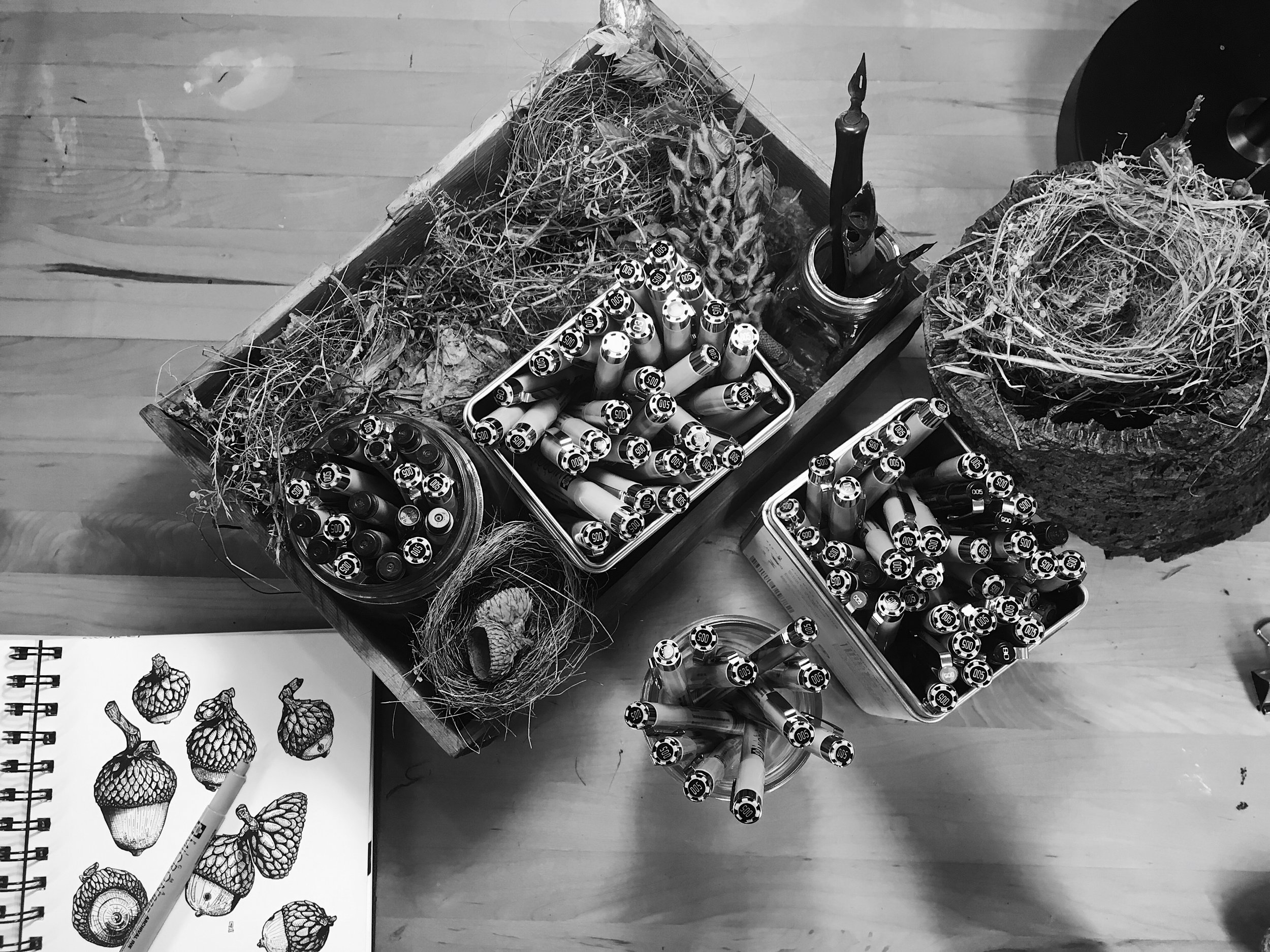
From the studio - used supplies
To get the details, I work with two types of ink drawing processes. The first is with the classic fountain pen, dipping the nib in Indian or Chinese black ink. I use this traditional approach when I want more variation in line and the details to be small, but not microscopic. These drawings become more expressive overall.

The second type is my go to. While not a time honored tradition, the Sakura Pigma Micron Pens and those like it are as close as you can get to a traditional pen and ink approach with absolute control over line consistency. I almost exclusively use the 005 (.20mm) tip for the finest of detail work. I go through a lot of these depending on the size of drawing and fiber complexity of paper used. I find a lot of joy when you step back from one of my creations and see the image as a whole... and how you can step so close to it that you discover a micro environment full of little surprises and textures weaving a tapestry together.
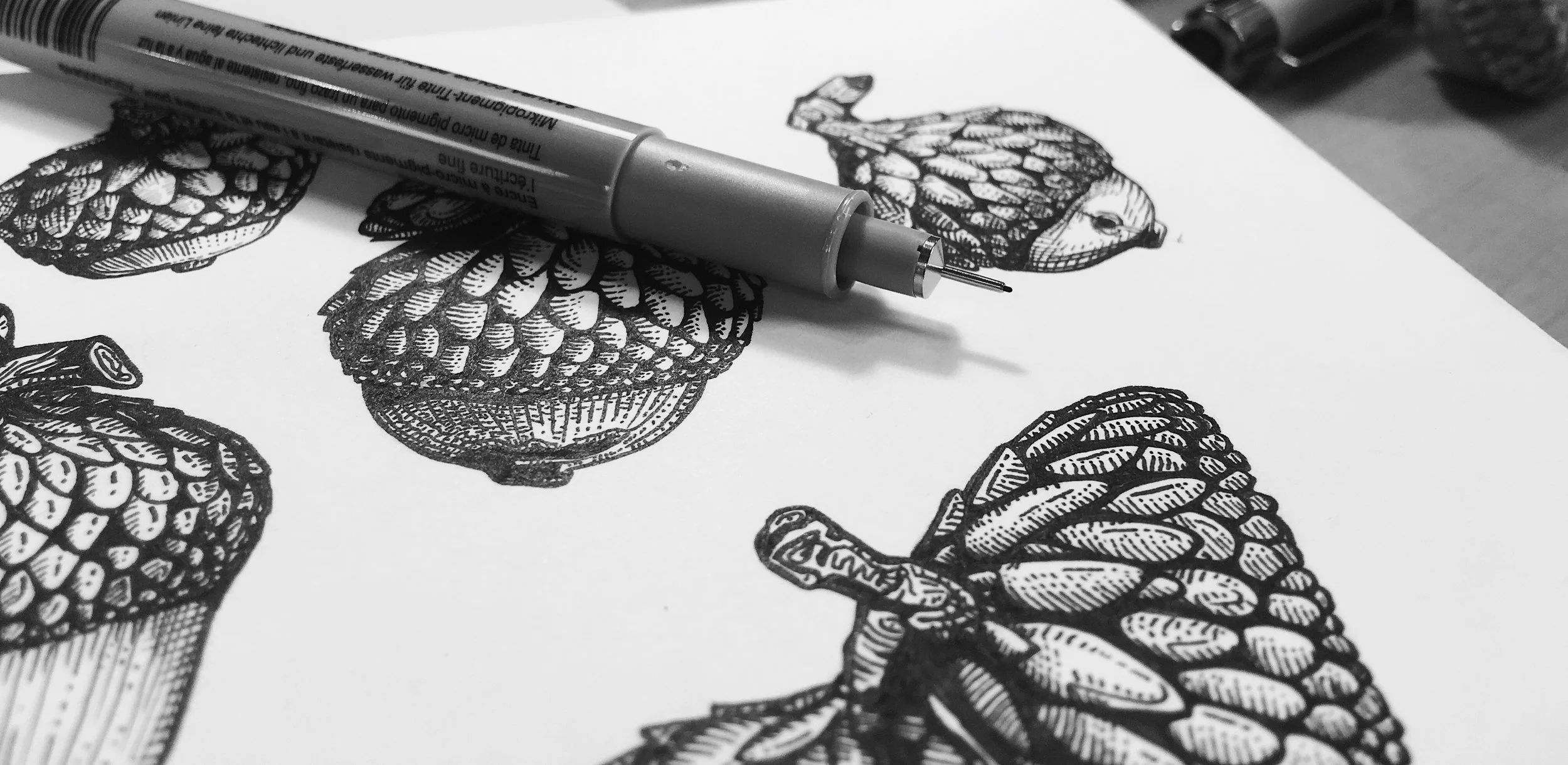
Why all the effort? Why a small line in each detail to make the whole? The millions of lines that make up textures and patterns in my work are nothing compared to what we discover in nature. I remember getting a marco view of a micro subject like a leaf and saying to myself, "wow, I'm missing a whole world of detail here." I want to capture that idea in my work. In every feather or cell organization, pattern of wood or acorn hat. Life is so interesting at this close-up range and it reminds me of who we are how things can look so similar on the surface, yet so vastly different in the details. Not only this, the repeating patters of nature are so incredibly intriguing: Fractals, spirals, meanders, waves, foams, tessellations and so many more. I can study the science behind the partners of life forever, but when I look at a pufferfish pattern, I just stop in my wonder of it all.
I hope you enjoy the work at the surface, but really fall in love with the details. Don't try to count the lines, I've tried. A simple, life sized Ginkgo leaf drawing I create has over 1,000 lines. The leaf fan is roughly 3-4 inches wide and 5 inches tall with it's stem attached.
Now I push. How many more lines and patters can I pack into that small of space. We'll see.
For the question, how long does it take? Each piece is different. I find the more I need to clear my head and focus the more detailed the piece becomes. Therefore I spend more time on it. The best art isn't created from a time constraint, but great works can come in a single sitting, or over years of labor. I guess what I'm saying is, "it all depends..."
- Andrew